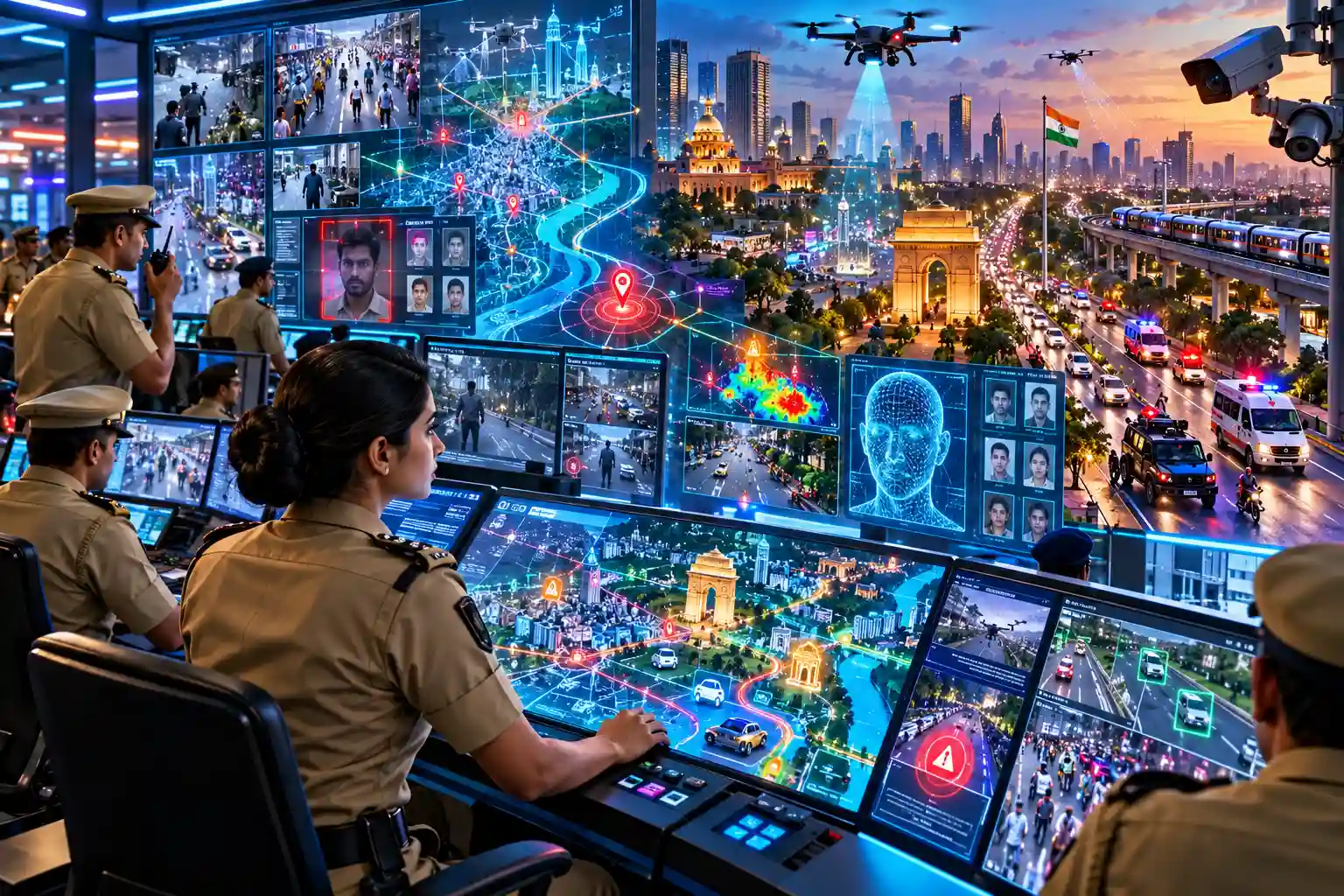
A patrol team can watch one street corner at a time. A facial recognition system can scan thousands of frames from a railway station in the time it takes an officer to finish a cup of tea. That gap in scale is the real reason police departments are adopting AI, not because it’s trendy, but because case backlogs, staffing shortages, and rising data volumes have made manual review unsustainable.
This isn’t a story about robots replacing officers. It’s about where AI genuinely reduces the load on investigators and where departments still need to proceed carefully. If you’re building a business case for AI adoption in your department, or trying to separate real capability from vendor marketing, this breakdown is for you.
Key Takeaways
- Facial recognition, video analytics, and predictive crime-pattern analysis are the three AI applications with the strongest operational track record in policing today.
- In a 2025 Axon survey of over 500 public safety professionals, three in four officers said they expect AI to improve their productivity and investigative accuracy.
- Predictive policing tools carry real bias risk when trained on historical crime data with existing enforcement disparities, according to the U.S. Department of Justice’s 2024 report on AI in criminal justice.
- Adoption is still uneven: a Michigan statewide survey found only 3% of local police agencies used AI or predictive tools for policing, even as camera and surveillance tech adoption grew sharply.
- Trust and transparency, not just accuracy, determine whether an AI tool succeeds in the field. Departments that pair deployment with clear governance policies see better public and internal buy-in.
Where AI Is Already Doing Real Work in Policing
Facial Recognition and Video Analytics
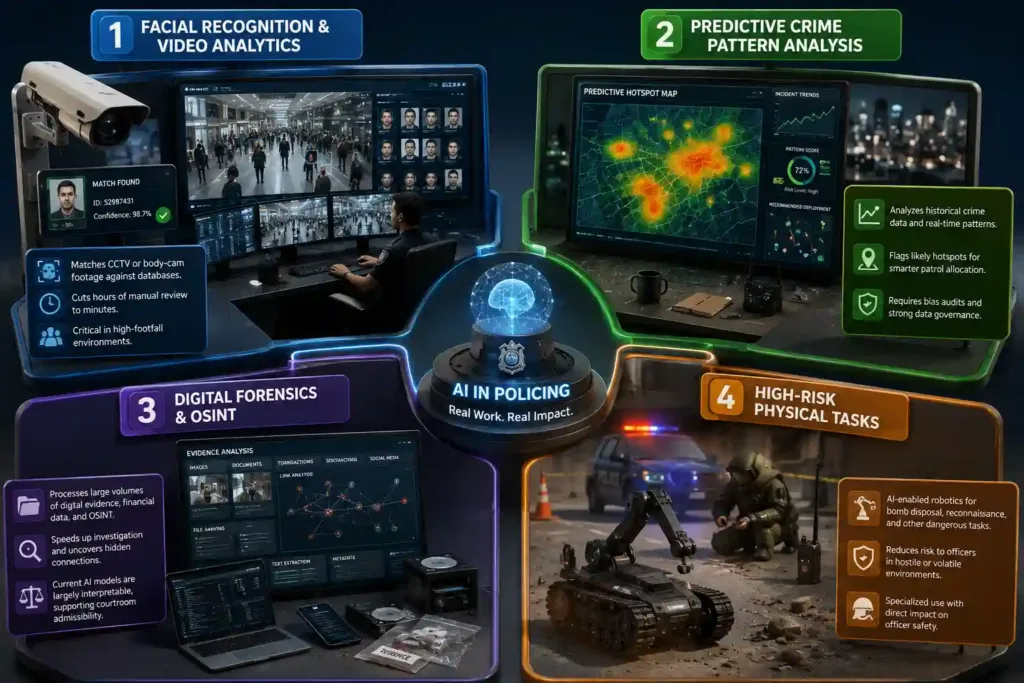
Facial recognition is the most mature AI application in law enforcement, and it’s also the one under the most scrutiny. Departments use it to match CCTV or body-camera footage against existing databases, cutting down hours of manual video review to minutes.
This matters most in high-footfall environments: airports, railway stations, and large public events where a handful of officers physically cannot scan every face in a crowd. The U.S. National Institute of Standards and Technology (NIST) runs ongoing, independent accuracy evaluations of facial recognition algorithms from vendors worldwide, which is the benchmark most serious procurement teams should be checking before selecting a system, rather than relying on vendor-reported accuracy alone.
Predictive Crime Pattern Analysis
Predictive tools ingest historical crime data, incident reports, and location patterns to flag likely hotspots for patrol allocation. The Organisation for Economic Co-operation and Development (OECD) documented 200 real-world government AI use cases across 11 core public functions, including a system built by Korea’s National Police Agency and Internet and Security Agency that analyzes real-time surveillance data to flag stalking risk indicators and warn potential victims before an incident occurs.
The catch: predictive policing is only as fair as the data behind it. The DOJ’s December 2024 report on AI in criminal justice is direct about this: the data used for predictive policing may have significant gaps and errors, and it may reflect human biases, and models trained on that data can entrench existing disparities and produce unintended, unjust outcomes. This is a data governance problem, not a reason to avoid the technology, but it’s a reason to insist on regular bias audits before scaling any predictive system department-wide.
Digital Forensics and OSINT
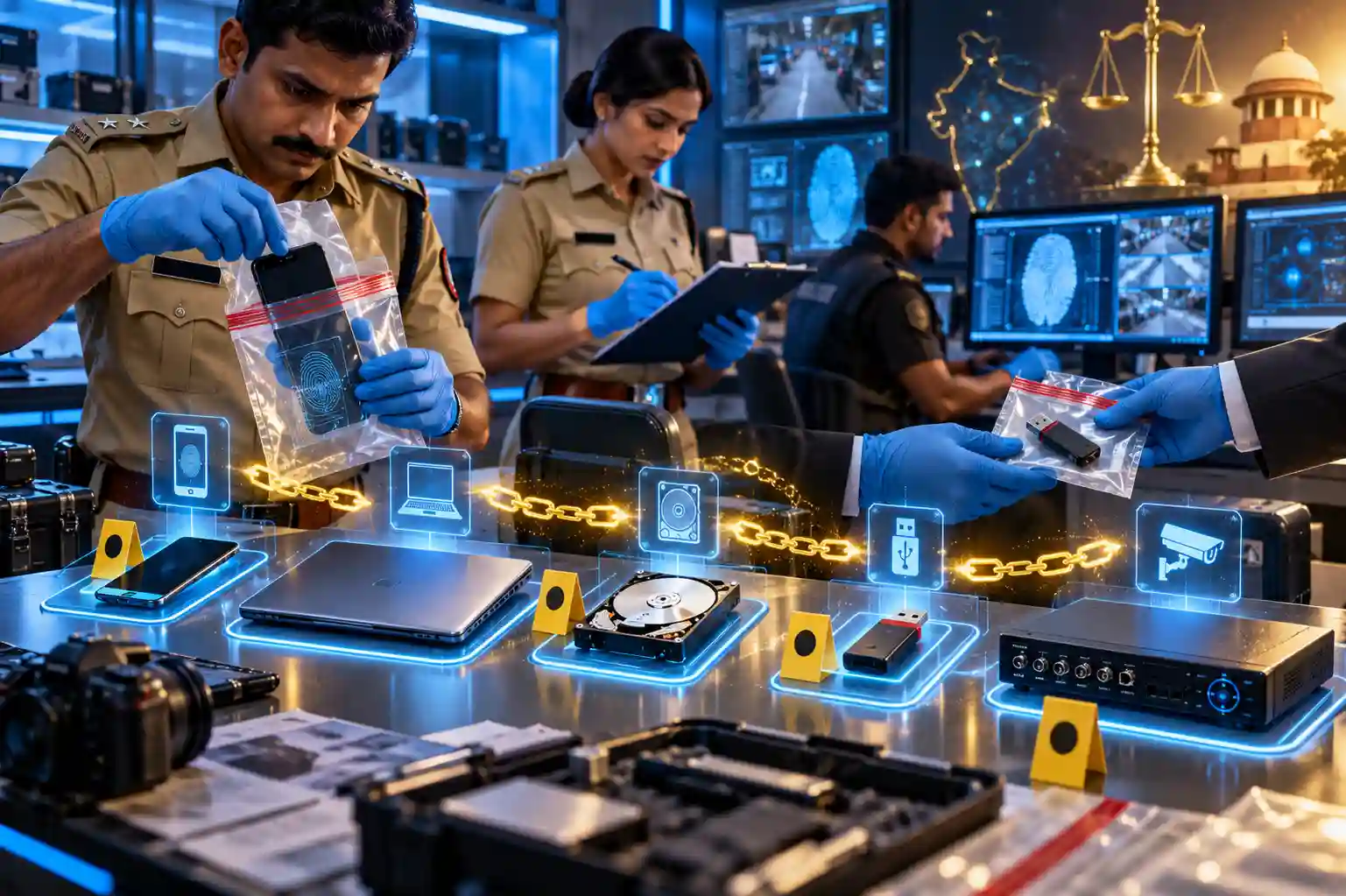
AI-assisted forensic tools help investigators process large volumes of digital evidence, financial transaction data, and open-source intelligence faster than manual triage allows. The DOJ report notes that current forensic AI models are largely interpretable, meaning an expert can explain how specific inputs lead to particular outputs, which matters directly for evidentiary standards and courtroom admissibility.
High-Risk Physical Tasks
AI-enabled robotics are used for tasks too dangerous for personnel to handle directly, such as bomb disposal or reconnaissance in hostile locations. This remains a narrower, specialized application compared to facial recognition or analytics, but it directly reduces risk to officers in the field.
What the Research Says About Adoption and Effectiveness
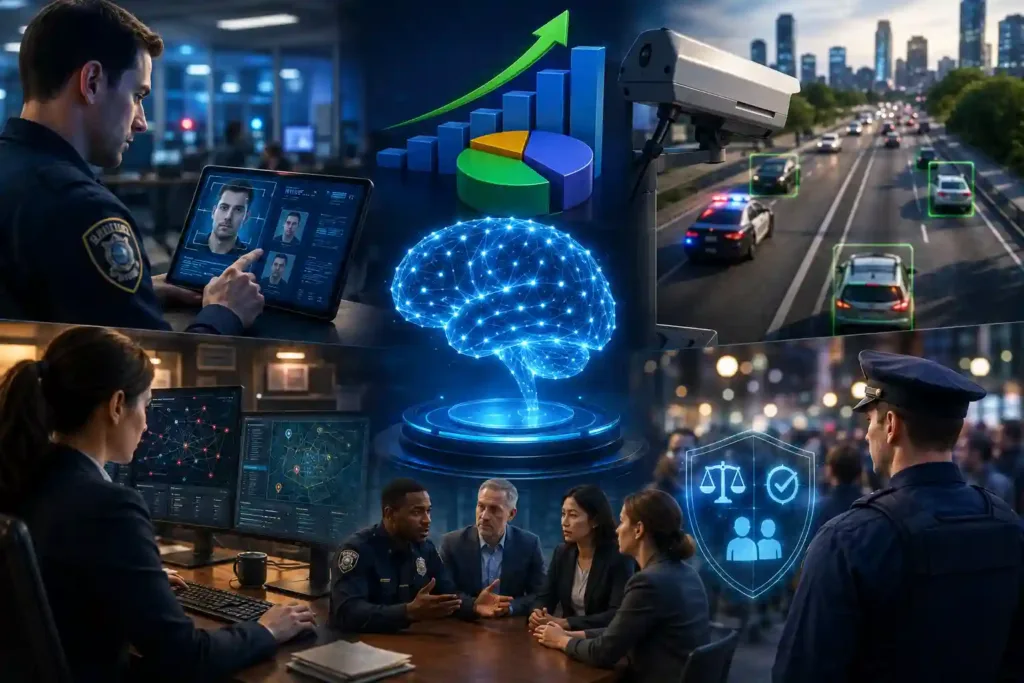
The productivity case for AI in policing has decent survey support. In Axon’s 2025 AI in Law Enforcement Trends Report, which surveyed more than 500 public safety professionals across the U.S., three in four officers said they believe AI will improve their productivity and investigative accuracy.
But actual field adoption still lags interest. A Spring 2024 statewide survey of Michigan local government leaders found that while 26% of police agencies used automated license plate readers and 10% used facial recognition, only 3% reported using AI or other predictive tools for policing. Camera and surveillance technology use grew significantly between 2015 and 2024, but predictive AI adoption has not kept pace.
The National Policing Institute’s review of current research points to why trustworthiness is a major factor in the acceptance of emerging technologies, and aligning AI implementation with public expectations around fairness, trust, and transparency is critical to legitimizing its use in law enforcement. In other words, the technology being accurate isn’t enough. It has to be deployed in a way officers, oversight bodies, and the public can actually trust.
Building an AI Policing Program That Holds Up to Scrutiny
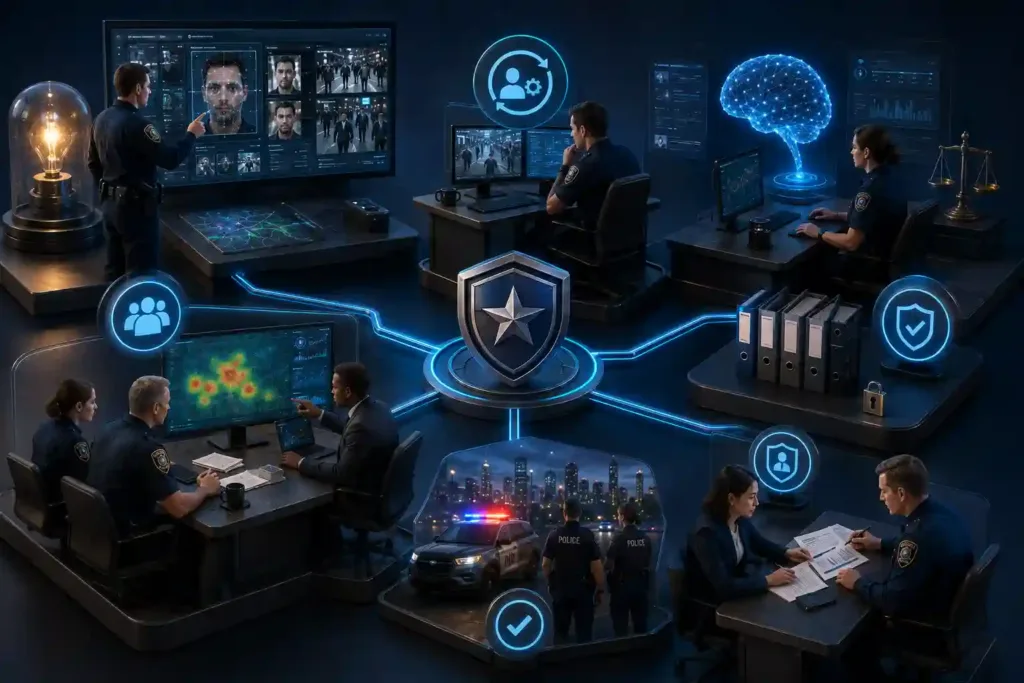
Departments that get this right tend to follow a similar pattern:
Start with a defined, high-value use case. Facial recognition for identifying persons of interest from existing footage, or analytics for surveillance in high-density public spaces, are narrower and easier to govern than an open-ended “AI for policing” mandate.
Build in human review at every decision point. Researcher Eric Halford’s risk-assessed framework for UK policing, covering more than 40 potential AI functions from criminal investigation to intelligence analysis, is built around the same core finding as the DOJ report: AI can analyze complex, massive data sets far faster than a person, but the technology is still evolving and requires human involvement, oversight, and strong governance frameworks.
Audit for bias before scaling. Any tool trained on historical crime data should go through a documented bias review before it’s used to guide patrol deployment or resource allocation, not after a complaint surfaces.
Set clear data retention and privacy policies upfront. This is as much a legal requirement as an operational one, and it’s the fastest way to lose public trust if handled reactively rather than by design.
Pilot before department-wide rollout. Given how uneven current adoption is, a controlled pilot with measurable outcomes gives you the evidence needed to justify wider investment and gives oversight bodies the transparency they’ll ask for regardless.
If your department is at the stage of evaluating facial recognition or predictive analytics platforms, our [facial recognition and biometric identification solutions] and [predictive crime analytics platform] are built around exactly this kind of governed, audit-ready deployment model. You can also see how we support investigative teams with [OSINT and threat intelligence tools] for digital evidence and case-building.
FAQs
1. Does AI replace police officers?
No. Every major research body covering this space, including the DOJ and OECD, frames AI as a tool that supports investigation and resource allocation, with human officers retaining decision-making authority, particularly for anything involving detention, arrest, or use of force.
2. Is predictive policing accurate?
It can meaningfully improve resource allocation when the underlying data is clean and regularly audited. But the DOJ has explicitly flagged that predictive tools can inherit and amplify bias from historical crime data, so accuracy depends heavily on data quality and ongoing oversight, not just the algorithm itself.
3. How accurate is facial recognition technology for law enforcement use?
Accuracy varies significantly by vendor and by conditions (image quality, lighting, database size). NIST runs independent, ongoing evaluations of facial recognition algorithms and publishes comparative accuracy data, which is the most reliable reference point for procurement decisions rather than vendor claims alone.
4. Why haven’t more police departments adopted AI yet?
Survey data suggests trust, governance clarity, and budget, not lack of interest, are the main barriers. Camera and surveillance technology adoption has grown quickly, but adoption of predictive AI tools specifically remains low across most agencies surveyed.
5. What’s the biggest risk in deploying AI for policing?
Bias in predictive systems trained on historical crime data and insufficient transparency with the public about how and when AI tools are used. Both are governance problems that can be addressed with audits, clear policy, and human oversight at every decision point, not reasons to avoid the technology outright.
If your department is exploring where AI fits into your current investigation or surveillance workflow, [schedule a demo with our team] to see how our solutions are built for governed, real-world law enforcement deployment.